Solar PV and battery storage for homes across the BA3 postcode area, designed after an in-person roof survey and installed by our own electrician-led team.
No obligation · Reply within one working day · Or call 01225 431219
Want a number first? See my price in 2 minutes
Midsomer Norton, Radstock and Westfield sit within Bath & North East Somerset, the same council as Bath, so the planning and conservation-area questions we deal with in the city apply here too. Villages to the south, including Chilcompton, Stratton-on-the-Fosse and Coleford, fall under Somerset Council. We check which rules apply to your address before we design anything.
You get the same service we give Bath homeowners: an in-person survey, a system designed around your roof and electrics, and one fixed price covering panels, inverter, scaffolding and installation. If your project needs more thought than a few panels on a south-facing slope, that's the work we're set up for.
Both towns grew up on the Somerset coalfield, and the housing still reflects it. Roof type and orientation change street by street, so we confirm both at the survey rather than guessing from a satellite photo.
Common in Radstock town centre. Rear slopes are often long and narrow, chimneys and neighbouring roofs can cast shade, and scaffold access sometimes has to come from the front. East and west-facing arrays are normal here and still work well.
Midsomer Norton has plenty, including around Welton and Westfield. Hipped roofs reduce the usable area, and concrete interlocking tiles need the right roof hooks. Electrics of this age are worth checking before a battery goes in.
Such as those off Frome Road and around Writhlington. Roofs are usually in good condition with modern consumer units, which keeps installs straightforward, though some have shallow pitches or limited space for an inverter and battery.
Around the edges of BA3, older stone properties often have slate or clay roofs nearing the end of their life. That's where it can make sense to deal with the roof and the solar together.
Parts of both town centres are in conservation areas. That adds conditions rather than a ban, and rear slopes are usually fine. Our guide to conservation-area rules covers how B&NES treats solar.
Detached homes with outbuildings, three-phase supplies or high usage can take bigger systems, but often need network approval before installation. We handle that application.
A battery isn't automatically worth it. It makes most sense where a lot of your electricity is used outside daylight hours, or where your tariff rewards shifting when you use it. It's most likely to suit homes with:
We size the battery from your usage and tariff, and we'll tell you if a battery doesn't add up for your household. Not sure where you stand? Try our Solar Suitability Check.
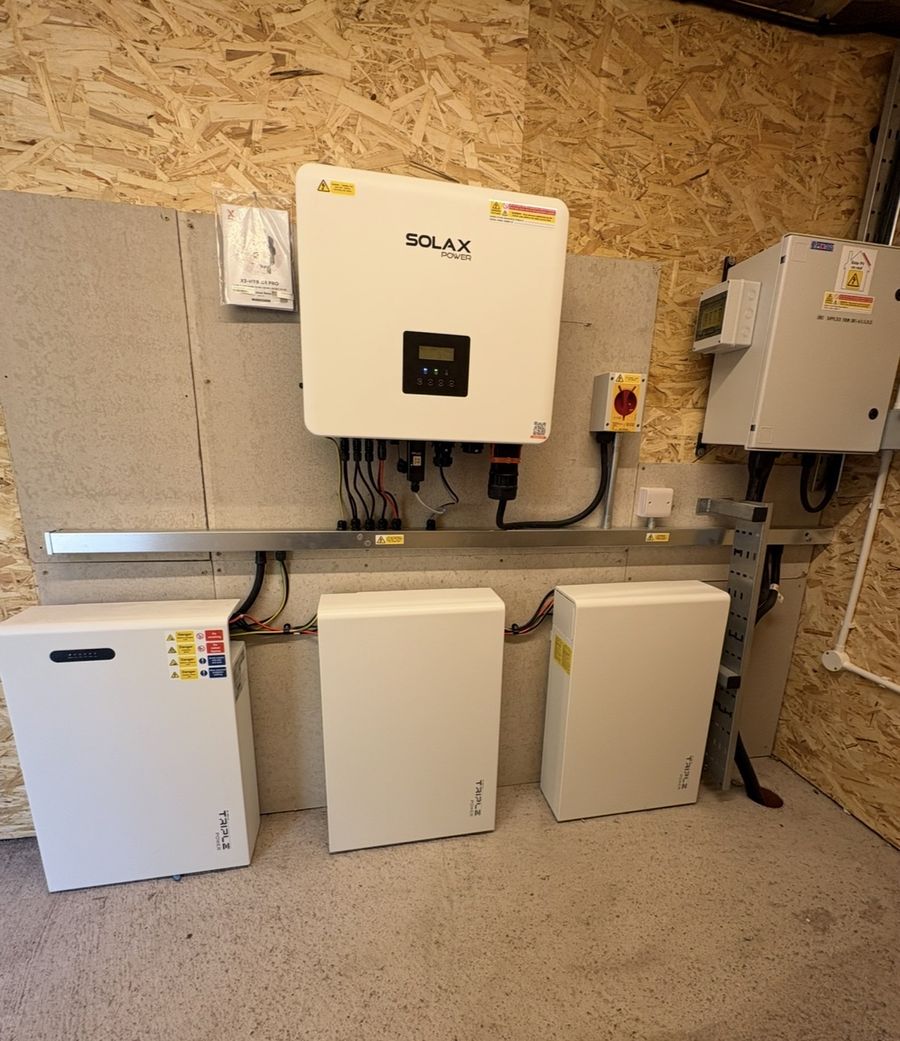
A SolaX hybrid inverter and 17.4kWh battery bank we installed on a project in Bath.
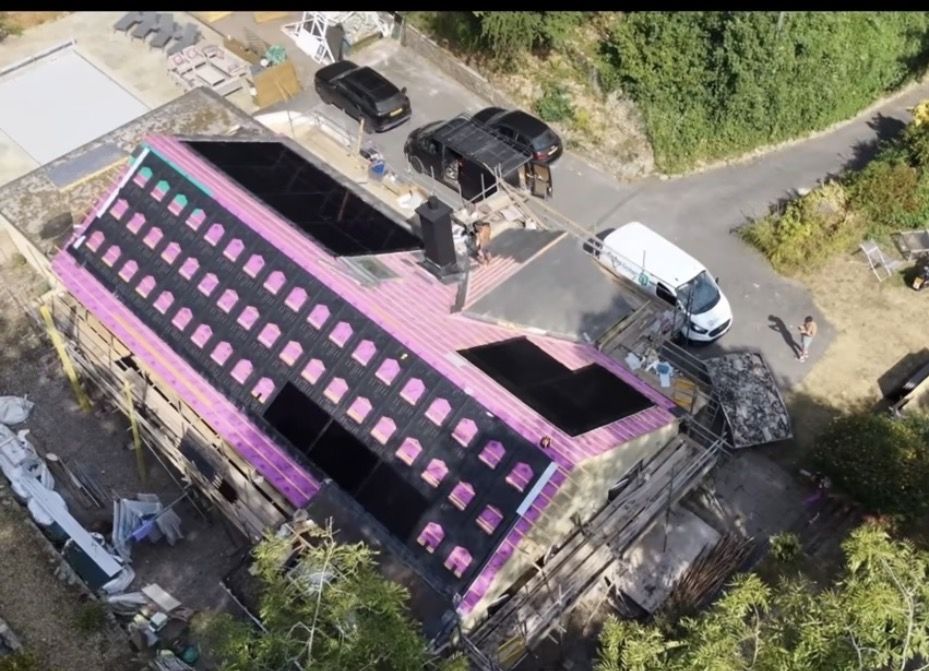
Mid-project on our 21kW reroof and in-roof solar job in Bath.
If your roof is ageing, putting a long-life solar system on it can mean scaffolding up again in a few years to lift the panels off. Doing the roof and solar together avoids that. Cube coordinates the whole project from survey to handover: the roofing is carried out by our roofing specialists as part of the Cube project, and the solar, battery and electrics by our own team.
On a full reroof, the panels can also be built into the roof itself so they sit flush with the tiles.
Cube Solar is led by Matt, a NICEIC-registered electrician with 20 years on the tools. The electrical design is done by the people who install it.
We visit in person, look at the roof by drone and from the ground, check the loft where we can, and look at your consumer unit and supply.
Panel layout, cable routes and the inverter position are worked out for your house, not copied from a standard kit list.
We fit Fox ESS, Sigenergy and SolaX hybrid systems (how they compare), and choose the inverter and battery size from your usage and supply (single or three-phase).
Multiple roof faces, in-roof systems and full reroof projects, like our 21kW in-roof job in Bath.
We prepare the G98 notification or G99 application with National Grid Electricity Distribution, including export limiting where it's needed.
We commission the system, arrange MCS certification so you can claim export payments, and hand over the paperwork and warranties.
Our own guarantee on the installation, alongside the manufacturer warranties. Warranties explained.
See the kind of work we do in our solar case studies, or meet the team.
We cover the whole BA3 postcode area, including:
Close by, outside BA3:
It depends on the usable area once hips, chimneys, vents, roof windows and the required edge clearances are allowed for, and on which roof faces are worth using. Hipped post-war semis usually fit fewer panels than their footprint suggests; terrace rear slopes are often long but narrow. We measure the roof at the survey and confirm the layout and system size in your quote.
Not necessarily. Without one, you use solar while it's generating and export the surplus. A battery earns its place when much of your use happens in the evening or overnight, when you have an EV or heat pump, or when you're on a time-of-use tariff. If the numbers don't support one for your household, we'll say so.
Usually, yes. On older homes we look closely at three things: the roof covering and timbers, the condition of slates or tiles around the array, and the electrics, because an old consumer unit or earthing arrangement may need upgrading first. Any of that is identified at the survey and priced in the quote, not discovered on the day.
Yes, and it's often the best time to do it. The scaffold is already up and the roof is open, so the panels can be planned into the new roof, or built into it with an in-roof system. Cube can manage the roofing, solar and battery as one project, with the roofing carried out by our roofing specialists.
We allow a week for a typical installation. That gives us time to fit the system, then test, commission and check everything properly before we hand it over, rather than rushing to get off site. In-roof systems and reroof projects take longer, and systems that need network approval first add lead time before we can book the install. We'll give you a realistic timeline at the survey.
Every grid-connected system has to go through the local network operator, National Grid Electricity Distribution. Smaller systems, up to 16A per phase (about 3.68kW on most single-phase homes), are notified after installation under G98. Larger systems, or solar and battery combinations above that limit, need G99 approval before installation, which can take several weeks. Export limiting can sometimes help. We prepare and submit the application.
Yes. A solar-aware charger can top up the car from surplus generation when you're at home in the day, and a battery and EV can share a cheap overnight tariff. Which approach saves more depends on when the car is home and how far you drive. Our guide to solar EV charging sets out the options.
Enough to cover the electricity you use after the panels stop generating, plus any overnight-tariff charging you want to do, without paying for capacity that sits unused. That depends on your usage, your tariff and whether an EV or heat pump is in the picture, so we size the battery after looking at how your household uses power rather than quoting a standard size.
Around £6,000–£8,000 installed for a standard 4kWp system. Battery storage adds £3,000–£5,000 depending on size. Qualifying residential solar and battery installs are 0% VAT (until 31 March 2027). Every quote is fixed after an in-person survey.
We'll visit, look at the roof and your electrics, and give you a fixed quote. If solar isn't right for your home, we'll tell you.
Tell us a little about your home and we'll arrange a visit. No obligation, and we'll come back to you within one working day.
Prefer to talk? Call us on 01225 431219
Want a number first? See my price in 2 minutes →